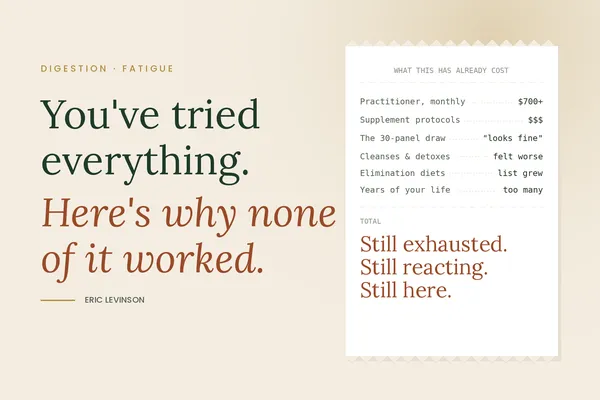
An itemized list of what chronic illness has already cost, with no result.

Why Nothing Has Worked

August 06, 20269 min read

There is a folder. Sometimes it is an actual folder, sometimes a shoebox, sometimes a note on a phone that has been added to for six years. Inside it are lab results from four different practitioners, a stool panel that cost four hundred dollars, printouts about a diagnosis that named your symptom without explaining it, and a list of foods you can no longer eat that has only ever gotten longer.

You did the work. That is the part that gets lost.

You read the books and listened to the podcasts and took notes at eleven at night. You paid a practitioner more per month than your car payment. You cut the gluten, then the dairy, then the nightshades, then the FODMAPs, then the histamines. You did the cleanse even though it made you feel like you had the flu for nine days, because you were told that meant it was working. You still have the drawer of half-used bottles, and that drawer is physical proof that the problem here was never your effort.

And you are still tired. Still reacting. Still eating something different from what your family is eating at your own table.

I spent fourteen years in that exact position, so let me say the thing nobody said to me during any of it. You did not fail those protocols. They failed you, and there is a specific reason why.

Every approach you tried shared one assumption

Look at the last five things you attempted and something uncomfortable emerges. Underneath completely different philosophies, they were all doing the same operation.

The elimination diet removed foods. The cleanse removed organisms. The fast removed eating. The parasite protocol removed what was living in the mess. The low-histamine phase removed more foods. Every single one of them worked by taking something away from a body that was already running short.

The logic makes sense on its face. Something is wrong, so find the offending thing and get rid of it. That is how you deal with a splinter.

The problem is that a body producing symptoms across your digestion, your energy, your skin, your cycle, your sleep, and your mood is not dealing with a splinter. It is doing something on purpose, in response to conditions, and taking things away from it does not change the conditions.

So relief arrives for about six weeks. Then it stops arriving. Then the list gets longer, because now you are reacting to foods you used to handle fine, and everyone around you reads that as the diet revealing more sensitivities rather than as evidence that the approach itself is producing them.

The practitioner problem

I want to be careful here, because plenty of good people work in this field and some of my own clients are practitioners.

What I am describing is a business model rather than a group of individuals.

Run a sixty-marker functional panel and you will find something. That outcome is guaranteed before the sample ships, because functional reference ranges are deliberately narrower than conventional ones and probability takes care of the rest. Ask a body sixty questions with tight windows on each and several will land outside the window in someone who feels completely fine. Then the report arrives with recommendations attached, and underneath the recommendations sit products.

Epstein-Barr gets flagged constantly. Roughly ninety percent of adults carry those antibodies, including everyone you know who feels great. Candida turns up because candida lives in the human gut. Dysbiosis turns up because your microbiome shifted based on what you ate last week.

Each number came from your body, so each number is real. Whether any of them explains why you cannot get off the couch is a separate question, and the report has no way to ask it.

Three months later you retest. If the numbers moved and you feel the same, you are told to stay the course. If the numbers held, compliance must have slipped somewhere. Both roads produce another protocol, another order, another three months.

That is the machinery. It is not a diagnostic process, because a diagnostic process can produce an answer that ends the process.

Then there is the lab that came back normal

This one causes more damage than any of the others, because of what it does to how you see yourself.

You go in feeling like you are running on twenty percent. The blood work comes back clean. Maybe a doctor says something like "I don't know how you're functioning," which is meant kindly and lands like a verdict. There is nothing measurably wrong with you, so the problem must be somewhere in your head, your stress levels, your perception, your hormones, your age.

Here is what a standard panel is built to do. It rules out disease. It answers the question "does this person have a nameable pathology that requires intervention," and when the answer is no, the panel has done its job correctly and completely.

It was never designed to answer the question you actually walked in with, which is why you feel like this.

A normal panel and a body in trouble coexist easily, and the specific case where they coexist most reliably involves iron.

Iron, and why your iron labs did not catch it

A standard iron panel measures the iron in your blood. Your blood is the delivery system. It is not where the damage happens.

When the body is dealing with ongoing inflammation, it does something protective. It pulls iron out of circulation and locks it inside cells and tissue, which is a reasonable defensive move because pathogens need iron to grow. That process is driven by a hormone called hepcidin, and none of this is fringe. Medicine has a name for the resulting picture already: anemia of chronic inflammation.

Which leaves a piece of arithmetic that is genuinely cruel. Blood iron reads low or perfectly normal. Tissue iron keeps climbing. The worse things get underneath, the cleaner the panel can look.

Ferritin adds another layer, because ferritin is supposed to indicate stored iron but also rises on its own in response to inflammation, independent of how much you are actually carrying. A normal ferritin means nobody looks further. A high one gets waved off as inflammation. Either way you leave the appointment with nothing.

One of my clients is a physician. His inflammation marker was over 250 and he was too weak to stand up. He put it more precisely than I can: anemia does not mean deficiency, it just means it is not showing up where we are testing. His marker is undetectable now, and when the inflammation came down, his iron came up on its own without anybody supplementing it.

If a doctor has you on prescribed iron, do not stop it because you read this. Take the question to them.

Different doors, same room

People arrive at this from wildly different starting points, and the entrance rarely resembles the entrance next to it.

Accutane as a teenager. Lyme. A long course of antibiotics. Birth control for a decade. HRT. A pregnancy that you never quite recovered from. A surgery. Going vegan for three years. Serious fasting. An iron supplement or a transfusion. Never having been breastfed. A period of stress so sustained that your body stopped treating it as temporary.

None of those look alike. They all deposit people in the same place, which is a body operating in survival mode, running on stress hormones, carrying iron it can no longer put where it belongs.

Once that state establishes itself, it stops needing the original trigger. Stress traps iron. Trapped iron drives inflammation. Inflammation traps more iron. The thing that started it can be a decade in the rear view and completely irrelevant to what is happening now, which is why hunting for the original cause so often goes nowhere useful.

And it explains why your symptoms look scattered. Digestion, fatigue, skin, cycle, mood, sleep, joints. Those are not six problems. They are one process showing up wherever you happened to be weakest, which is why you have six specialists who each own one branch and nobody looking at the tree.

Why the healthy things made it worse

This is the part that tends to land hardest, and it explains the thing you could never make sense of.

A body in survival mode reads restriction as threat. Fasting is a threat. Extended low carb is a threat. Cutting calories is a threat. A cleanse is a threat. So is the anxiety of tracking every ingredient and getting it exactly right, because the body does not distinguish between a physical stressor and a psychological one.

So every disciplined, well-intentioned thing you did to fix this was interpreted by your body as further evidence that conditions were dangerous, which deepened the exact state producing your symptoms.

You were working against your body while believing you were working with it. Nobody told you the difference, and the harder you worked, the more the effort cost you.

What actually changes it

The direction reverses.

Instead of removing things from a body under threat, you reduce the threat and give it what it has been short of, which is what allows it to release and regulate on its own. Bodies are good at this when the conditions permit it. Yours has been operating under conditions that did not permit it, for years, while every intervention made those conditions worse.

That is why my clients eat more rather than less, eat what their families eat from the same pot, and generally take fewer supplements than they walked in taking. It is also why the changes show up in things nobody expected, like sleep and mood and skin, alongside the digestion they came in for.

I am not going to lay out the mechanism here. There is too much of it, it requires the whole picture in order, and half of it delivered badly is worse than none. I put the full explanation into a free class, including how iron accumulates in the first place, why the standard panels miss it, how to tell whether this describes you specifically, and what changing the conditions actually involves.

It costs nothing and there is nothing to buy at the end of it. It will make more sense of your last ten years than any appointment you have paid for.

Watch the free class


Eric Levinson Coaching provides health coaching and education. It does not diagnose, treat, cure, or prevent any disease, and it is not a substitute for care from your physician. Always consult a qualified healthcare provider before changing your diet, supplements, or care, particularly with a diagnosed condition. Individual results vary.

Eric Levinson

Eric Levinson

Eric Levinson spent fourteen years being the person most of his clients are when they find him. Lyme, Accutane as a kid, years of antihistamines and allergy shots, then every diet, cleanse, and protocol he could find, several of which made things worse. The turn came when he stopped treating his body as broken and started looking at the conditions it was responding to. He has coached since 2011 and works with adults and children on metabolic health, with a focus on stress physiology and iron regulation. His clients include physicians and other practitioners. He lives in Asheville, North Carolina.

Instagram logo icon
Back to Blog