
Why “Liver Cleanses” and “Parasite Detoxes” Usually Make You Worse — Not Better
If you’ve been told your fatigue, bloating, skin issues, brain fog, or inflammation are caused by “toxins” or parasites — and that the solution is another cleanse, detox, fast, or restrictive protocol — this article may completely change the way you think about healing. Learn why aggressive detoxes often worsen metabolism, stress hormones, inflammation, and iron dysregulation… and why true detoxification depends on energy production, insulin sensitivity, muscle mass, and metabolic resilience instead. This article breaks down the anatomy and biochemistry in simple terms so you can finally understand why the body doesn’t need to be “cleansed” — it needs to be supported.
Eric Levinson
5/7/20265 min read
Why “Liver Cleanses” and “Parasite Detoxes” Usually Make You Worse — Not Better
If you spend any time in the health world online, you’ve probably seen dramatic claims about “toxic livers,” hidden parasites, or mysterious sludge supposedly leaving the body during a cleanse.
The promise is seductive:
“Flush toxins.”
“Kill parasites.”
“Detox your liver.”
“Reset your gut.”
“Release stored waste.”
And at first, many people actually feel something.
They may lose weight quickly.
Their digestion changes.
Their stools look unusual.
They feel lighter or stimulated.
So they assume the cleanse is working.
But in many cases, what’s really happening is not healing — it’s a stress response.
And over time, these aggressive detox approaches often worsen the very symptoms people are trying to fix: fatigue, bloating, brain fog, hormonal issues, skin problems, anxiety, insomnia, constipation, inflammation, and poor digestion.
The problem is that most detox advice completely misunderstands how the human body actually removes waste.
Your body is not a dirty sink that needs to be flushed with herbs, coffee enemas, juices, or harsh antimicrobial protocols.
Your body already has a detox system.
The real issue is whether you have enough energy to run it properly.
Your Body Already Has a Built-In Detox System
Your body is constantly detoxifying every second of the day.
You have:
A liver that processes hormones, chemicals, iron, medications, and metabolic waste
Kidneys that filter blood
Lungs that remove carbon dioxide
Skin that helps regulate elimination through sweat
A digestive system that packages waste into stool
A lymphatic system that moves cellular debris
An immune system that identifies and neutralizes threats
The body is designed to eliminate waste naturally.
The question is not:
“How do I force detox?”
The real question is:
“Why has the body lost the energy needed to detox efficiently?”
That changes everything.
The Liver Does NOT Work Like a Drain Pipe
One of the biggest misconceptions is the idea that the liver becomes “clogged” and needs to be flushed out.
That’s not how anatomy works.
The liver is more like a biochemical processing plant than a filter full of sludge.
It transforms substances chemically so they can safely leave the body.
For example, the liver:
Converts ammonia into urea
Processes estrogen
Packages cholesterol
Regulates blood sugar
Stores glycogen
Helps regulate iron
Produces bile for digestion
Neutralizes metabolic waste
Every one of these jobs requires energy.
Specifically, the liver requires:
Adequate glucose
Oxygen
Thyroid function
Minerals
Mitochondrial energy production
Stable blood sugar
Low chronic stress signaling
When metabolism slows down, detoxification slows down too.
That’s why many people with “detox symptoms” are actually experiencing low-energy states driven by:
Insulin resistance
Chronic stress hormones
Poor sleep
Muscle loss
Undereating
Overtraining
Nutrient deficiencies
Iron dysregulation
Chronic inflammation
The Iron Connection Most People Miss
One of the biggest overlooked drivers of poor detoxification is iron dysregulation.
Iron is essential for life — but excess unbound iron is highly reactive.
When iron accumulates improperly in tissues, it can increase oxidative stress, damage mitochondria, and impair cellular energy production.
This matters because detoxification is an energy-demanding process.
When metabolism slows:
The liver struggles to process waste efficiently
Bile flow becomes sluggish
Digestion weakens
Constipation increases
Estrogen clearance worsens
Inflammation rises
People then interpret these symptoms as:
“I must have toxins.”
So they double down on cleanses.
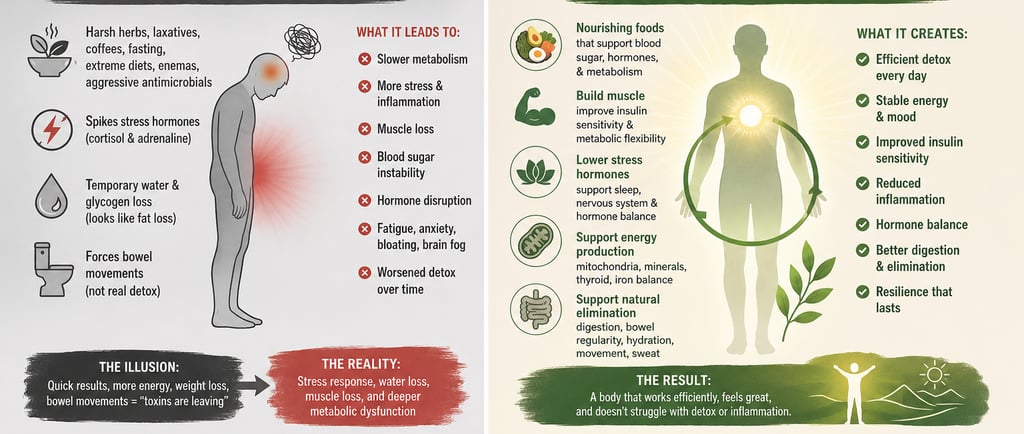
But many detox protocols actually increase stress hormones and inflammation further.
Why Cleanses Often Make People Feel Better Temporarily
This is where things get confusing.
Because many people do notice changes during a cleanse.
Why?
Several reasons.
1. Stress Hormones Create Temporary Stimulation
Many detoxes are essentially controlled stress.
Examples include:
Fasting
Extremely low-calorie diets
Harsh herbs
Laxatives
Excess caffeine
Coffee enemas
Aggressive antimicrobials
These increase adrenaline and cortisol.
Stress hormones can temporarily:
Suppress appetite
Increase alertness
Mobilize stored fuel
Reduce water retention
Speed bowel movements
So people feel a short-term “high.”
But long-term elevation of stress hormones damages metabolism.
2. Rapid Water Loss Looks Like Fat Loss
Many cleanses reduce carbohydrates and sodium.
This depletes glycogen and water.
The scale drops quickly, so people assume toxins are leaving.
But most early weight loss during detoxes is:
Water
Glycogen
Muscle tissue
Digestive contents
Not toxins.
3. Increased Bowel Movements Create the Illusion of Detox
If you suddenly stimulate the intestines with laxatives, magnesium overload, herbs, or enemas, you will produce more stool.
That doesn’t necessarily mean you removed toxins.
It often just means you irritated the intestines.
Many “parasites” people see in stool are actually:
Mucus
Intestinal lining
Undigested fiber
Congealed oils
Biofilm-like debris
Not actual parasites.
True parasitic infections do happen — but they require proper diagnosis, not social media guesswork.
Why Aggressive Detoxing Can Backfire
The body prioritizes survival above everything.
If detoxification becomes too aggressive, the body perceives danger.
This increases stress hormones and conserves energy.
Over time, this can lead to:
Slower metabolism
Poor thyroid conversion
Reduced digestive capacity
Muscle loss
Blood sugar instability
Hormonal disruption
Fatigue
Anxiety
Insomnia
Ironically, the more people try to “force detox,” the more burdened they often become.
The Body Detoxes Best in a High-Energy State
Real healing happens when the body has enough energy to safely process and eliminate waste continuously.
That means supporting metabolism instead of attacking the body.
The goal is not to “push toxins out.”
The goal is to improve the body’s natural ability to manage stress and maintain efficient elimination.
What Actually Improves Detoxification
Improve Insulin Sensitivity
Insulin resistance disrupts energy production and increases inflammation.
Improving insulin sensitivity helps:
Stabilize blood sugar
Reduce oxidative stress
Improve liver function
Lower stress hormones
Support mitochondrial function
This is one reason muscle-building is so powerful.
Muscle acts like a glucose sink and improves metabolic flexibility.
Build Muscle
Muscle is one of the most protective organs in the body.
More muscle helps:
Improve glucose disposal
Reduce insulin resistance
Lower inflammation
Increase metabolic rate
Improve mitochondrial function
Support hormone balance
Muscle is not just cosmetic.
It’s metabolic protection.
Lower Chronic Stress Hormones
The body cannot heal efficiently in a constant fight-or-flight state.
Chronically elevated cortisol and adrenaline impair:
Digestion
Liver function
Thyroid conversion
Sleep
Hormone balance
Immune function
This is why healing often requires:
Adequate calories
Sufficient protein
Proper carbohydrates
Mineral replenishment
Rest
Sleep
Nervous system regulation
Not more restriction.
Support Natural Elimination Pathways
Instead of “forcing detox,” support the systems already designed for elimination.
That includes:
Regular bowel movements
Good digestion
Proper hydration
Adequate protein
Nutrient density
Movement
Sweating appropriately
Sleep
Stable blood sugar
The body detoxes continuously when metabolism is functioning well.
The Real Goal Is Resilience, Not Cleansing
Health is not about constantly purging the body.
It’s about building resilience.
A resilient body:
Produces energy efficiently
Maintains stable blood sugar
Handles stress effectively
Eliminates waste naturally
Regulates inflammation appropriately
Supports strong digestion and circulation
You do not heal by endlessly attacking the body.
You heal by giving the body the energy and resources it needs to function correctly.
That’s why the future of health is not more extreme detoxes.
It’s metabolic health.
If you’re tired of chasing detoxes, cleanses, supplements, and restrictive protocols that only leave you feeling more exhausted, inflamed, and stressed, it may be time to address the real root issue: metabolic dysfunction and iron dysregulation.
My Iron Regulation Method is designed to help support the body’s natural ability to produce energy, regulate stress hormones, improve insulin sensitivity, reduce inflammation, and restore efficient detoxification — without extreme restriction or aggressive cleansing.
If you’re ready to stop fighting your body and start building real resilience, energy, and metabolic health:
Click here to apply and book a free call to see if my Iron Regulation Method could help you not just resolve chronic stress symptoms, but achieve real resilience and create a body that works efficiently, feels great, and doesn’t struggle with detox or inflammation.
Connect
Follow
Subscribe
eric@ericlevinson.com
917-408-3048
© 2025. All rights reserved.